Tuesday, February 25, 2014

What about the Apocrypha?


The first record of the process of writing the Old Testament is God writing the 10 Commandments on stone tablets on Mount Sinai in Exodus 20. But only a few chapters later, in Ex 24:7, Moses has something which is described as the “book of the covenant”, which is probably Exodus 20-23, written down by Moses. From then, the Old Testament grew, through a process of editing and compiling various accounts, and people writing down messages given by God to inspired prophets, and so on. There's lots of detail, but it's very dull and the kind of thing boring academics argue about. It's far more interesting and helpful to talk about what the text means than try to come up with novel theories for how it came to be the way it is.

Peter sums up the overall process well:

Above all, you must understand that no prophecy of Scripture came about by the prophet’s own interpretation of things. For prophecy never had its origin in the human will, but prophets, though human, spoke from God as they were carried along by the Holy Spirit.2 Peter 1:20-21

The result, over a period of 1000 years or so, was the Tanakh. Tanakh is the Hebrew name for Torah (law) + Naviim (prophets) + Khetuvim (writings), and is pretty much exactly the 39 books of the Old Testament in most modern Protestant Bibles, but in a different order. It's written in Hebrew, with a few bits in Aramaic, which is closely related to Hebrew. It's possible a few bits (Daniel?) might have been written after the Greek conquest, but if so they were written in the old language, for the old culture and set before the conquest.

After the Exile to Babylon, the Jews gained a degree of independence under the Persian Empire, the beginnings of which are seen in Ezra and Nehemiah. But the Persian empire fell to Alexander the Great in 332BC, and over time Greek rule transformed Israel. Tensions occasionally rose as high as violent revolt, especially the one led by the Maccabees in 164BC, which led to an independent Jewish state until it was swallowed up by the Roman Empire.

However, most Jews lived outside Israel, in what is now Egypt, Syria, Turkey and Iraq, they spoke Greek rather than Hebrew as a first language and were heavily influenced by Greek culture in a way that the Palestinian Jews had largely resisted. These Jews translated the Tanakh into Greek, so they could read and study it more easily, with the result being the Septuagint (usually abbreviated to LXX). The LXX isn't quite a straight translation though. Some books (Jeremiah) are a bit shorter in the LXX. Others (Daniel, Esther) are a bit longer, with the addition of new stories to Daniel and explicit references to God and prayer in Esther. Some new books were added too - some stories (Tobit, Judith), some history (Maccabees), and some which fit the Greek/Jewish culture, like Wisdom of Solomon, which says how wonderful Greek philosophy is, then points out it's all there and even better in the Tanakh. The books were also in a different order, with the LXX closer to the order you'd find in most Bibles today.

That meant there were some striking differences between the Hebrew Scriptures, used by Palestinian Jews, and the standard Greek translation of it, used by Grecian Jews.


What about Jesus and the apostles?

Jesus and the first apostles were Palestinian Jews and therefore used the Hebrew Tanakh. Paul was at home in either culture – he was brought up in Turkey, but studied in Jerusalem – and although he quotes from the LXX when writing to Greek-speaking Christians, he only quotes from the bits which were translations of the Hebrew/Aramaic original.

By the end of Acts, however, the majority of Christians didn't speak Hebrew or Aramaic, only Greek, and this was stronger still after the destruction of Jerusalem in AD70. After that, the early church almost exclusively used the LXX for their Old Testament.

And the Jews?

Meanwhile, the Jews met to discuss the problem at the council of Jamnia, which is often seen as the start of Rabbinic Judaism (i.e. after the temple and the destruction of Israel). They agreed that the Hebrew Tanakh was indeed Scripture, but the extra bits in the Greek LXX weren't.

St Jerome

During the centuries of persecution, the LXX seems to have been fairly readily available. Judaism wasn't persecuted in the same way that Christianity was, and most churches seem to have owned and used the LXX as Scripture. When St Jerome was commissioned to translate the Bible into Latin in 382, he found the problems, and argued against the use of the extra bits in the LXX. Augustine countered, arguing that the LXX itself was inspired by God, even where it got the translation of the underlying Hebrew wrong. Jerome made some compromises and his translation (the Vulgate) became the standard translation in the Latin-speaking world. The Vulgate:

  • Translated the Hebrew text of the books in the Tanakh, but noted where the Greek disagreed.
  • Where there were extra bits in the LXX, translated them too but mostly tagged them on at the end of each book.
  • Kept the LXX book order, including the extra books.

And so it stayed for 1000 years.

The Reformation

In the 1500s, the Reformers rebelled against the established Latin Church. As part of this, they looked again at the question of which books should be in the Bible, and almost all of them concluded that the Old Testament we use should be the Hebrew Tanakh, not the Greek Septuagint. Luther, for example, translated the Old Testament from Hebrew into German, and relegated the books that were only in the LXX to an appendix to the OT entitled “Apocrypha: These Books Are Not Held Equal to the Scriptures, but Are Useful and Good to Read”. Luther's idea was widely copied. In the Church of England, the policy was (and remains) as follows:

And the other Books (as Jerome saith) the Church doth read for example of life and instruction of manners; but yet doth it not apply them to establish any doctrine.

Over time, the Apocrypha was dropped from most Bibles to save on printing costs and to make it clear that they aren't on the same level as Scripture.

Meanwhile, the Roman Catholic Church met at the Council of Trent to decide how to respond to the Reformation. One of the items on the agenda was which books should be in the Bibles, and Trent ruled that all the books in the LXX were Scripture.

The Situation Today

By and large, the situation today is as follows:

  • The Protestant Old Testament is the Hebrew Tanakh, but with the Greek order of books.
  • The Catholic Old Testament is the slightly weird Jerome-compromise of a combination between the Hebrew and Greek Old Testaments, but all held to be authoritative.
  • The Orthodox Old Testament is the LXX, with various slight variations among different groups.

And for those who are interested, the order of books in the Hebrew Tanakh is as follows:

  • Genesis – Deuteronomy (the Torah)
  • Joshua - 2 Kings, but missing out Ruth (the Former Prophets)
  • Isaiah, Jeremiah, Ezekiel (the Major Prophets)
  • Hosea – Malachi (the Minor Prophets)
  • Psalms
  • Job
  • Proverbs
  • Ruth
  • Song of Songs
  • Ecclesiastes
  • Lamentations
  • Esther
  • Daniel
  • Ezra - Nehemiah
  • 1& 2 Chronicles

(And that was the simplified version!)

Monday, February 24, 2014

Where did the New Testament Come From?

“prophets, though human, spoke from God as they were carried along by the Holy Spirit.” 2 Pet 1:21

Jesus was crucified and raised from the dead in either AD 30 or 33. By AD50, the church had grown enough that some of the leaders of the church needed to write to other bits of it (Galatians written in 48, 1 Thessalonians in 51, James maybe even earlier). The churches found these letters so valuable that they made copies of them, and circulated them to other churches as well, and reading them alongside the Old Testament. Even by the time 2 Peter was written (mid-late 60s?), people were evidently reading Paul's letters as Scripture (2 Pet 3:16).

Also in the 60s, the apostles started to realise that they were probably going to die before Jesus returned. Some of the apostles who had known Jesus (Peter, via his friend Mark; Matthew; John) wrote down accounts of what Jesus had done and said. They'd already been preaching this for 30 years; it's like writing an account of the Falklands War today, using the accounts of soldiers who fought there – the same sort of timescale. Books weren't in common use yet, but the early church very quickly created a scroll of the four gospels, which almost every early Christian church seems to have had access to, along with another scroll of the Letters of Paul.

For the next few hundred years, Christianity was illegal, and often persecuted. Printing, of course, hadn't been invented, and so churches tended to have a collection of scrolls of New Testament writings which they used. Besides Paul and the Gospels, they might well have some of the other NT letters (Hebrews-Revelation, especially 1 John), and maybe some other books like the letters of Clement, Bishop of Rome in the 90s.

In the 100s, lots of false teachers arose, just like Jesus said they would. Some of them (e.g. Marcion) tried cutting bits out of the Bible because they wanted to cut off any hints of Jewish roots. Others (e.g. the author of the Gospel of Thomas) wrote fake “gospels” to try to add things into the Bible which fit their own agenda. Irenaeus, bishop of Lyons in about 180, wrote about them and pointed out that the church had always had the 4 gospels and that they shouldn't accept any of the new nonsense. [If you want to, why not try reading some of these fake “gnostic” gospels – they're very different to the real thing, and can be quite funny in an awful way. They tell us far more about what the authors liked (secret knowledge, petty magic tricks) or didn't like (women) than about Jesus though.]

When Christianity eventually became legal, in the early 300s, the church started to compare notes on which books they had, and which ones were Scripture. Interestingly, they didn't discuss it at the Council of Nicea, which was the first big Christian get-together after Christianity was made legal – there were more pressing things to discuss like Jesus being God and the date of Easter. It wasn't so much a process of deciding which books were Scripture as recognising. If I pick someone out of a police line up, I'm not deciding that that person robbed my house; I'm recognising the person who did it.

The criteria the Church used were roughly:

  • Is it either by an apostle (leader of the early church personally commissioned by Jesus – Peter, John, Paul, James, etc), or was it approved of by an apostle (Luke, Mark)?
  • Does it fit with the rest of the apostolic teaching? (“Acts of Paul” was ditched as it clearly wasn't by Paul because it didn't fit with the rest of his teaching.)
  • Has it been used by a lot of Christians, and tested to see that it has the effects that we expect Scripture to have?

Using these criteria, Athanasius, bishop of Alexandria, wrote the list we've got today in his Easter Sunday letter of 367, and this was ratified by the Council of Carthage in 397. It's easy enough to find copies of the books that they decided to leave out – Shepherd of Hermas, 1 Clement, the Didache, and so on. They don't add much.

There's a different question, about how sure we can be that the New Testament we read today is what was originally written. Ian Paul, who knows more about these things than me, has some helpful comments.

As a consequence of all this, we can be very sure that what we have as the New Testament now is pretty much exactly what those who knew Jesus personally were saying and teaching about him in the Early Church.

Thursday, February 13, 2014

Whom do you serve?

We all serve someone or something, whether we intend to or not. The weird thing is that we sometimes get to choose who.

So the stereotypical career-obsessed man is actually serving his career, sometimes even becomes a slave to his career. Perhaps a clearer question is “Where do you seek fulfilment?” The person who seeks fulfilment through sporting achievement serves their sport – they give their energy, their time, their effort to their sport, sometimes to the exclusion of other things in their lives.

The Romans used to personify these ways of seeking fulfilment – the person who looked for it in wine and feasting was said to serve Bacchus; the person who looked for it in sex or war served Venus or Mars.

Against that background, God's first commandment to his people cuts like a knife. “You shall have no other gods in my sight.” Sure we can do sport, drink wine, work hard at our jobs, but we should seek our ultimate source of fulfilment in God alone.

For those of us who seek to serve God, there is, however, an even bigger danger. The second commandment begins “You shall not make for yourselves an idol...” The danger warned of in the first commandment is the danger of false pretenders to God's throne. The danger in the second commandment is of imposters pretending to be God.

How do we decide who God is? There are three choices. Either we listen to others, or we see what he has revealed to us, or we make something up for ourselves. When we follow others, there's a danger that we're just following what someone else has made up about God. When God says “You shall not make for yourselves an idol...”, he's telling us to avoid making our own pictures of what God is like, and to follow the picture he has already given us in the Bible and in Jesus, as described in the Bible.

Saying “I like to think of God as...” is pretty stupid anyway. Why should there be any relation between the way we like to think of God and the way he actually is? Since when is our personal preference a reliable guide to the nature of the one who created the universe? That isn't much that works like that in the world, is there? (And for any pedantic not-yet-Christians out there – yes, I realise this isn't arguing for Christianity, only against self-constructed images of God and towards ones which come from plausible sources of revelation).

It seems to me that there are three quite different pictures of God going round in the church at the moment, only one of which comes from the Bible.

There's the picture of God as grumpy judge, defender of Victorian morality and condemner of those sins which we're more likely to approve of now than the Victorians were such as sexual promiscuity. For some reason he seems less bothered by the sins which we're more likely to be against now, such as wife-beating. This picture of God doesn't have much room for a Jesus who was criticised for hanging out with tax collectors, prostitutes and other known and notorious sinners.

There's also his opposite – God as the personification of the Spirit of the Age. This God doesn't judge or condemn people, except maybe those who do violence against children or who condemn others. He is open to changing and evolving morality, and in fact isn't overly keen on being described as “he” at all. This picture of God doesn't leave room for a Jesus who is fully divine and yet began his ministry by calling people to repentance, or who died to take God's just punishment on sin on himself.

Neither of those is the real God. Both of them are idols, spirits of this age or of the previous one that we transplant onto God and then blasphemously claim to be the real God.

The real God is far too uncomfortable for either of them. He commands us to be discerning but never condemning, to be in the world but not of it, to genuinely love the sinner and genuinely hate the sin, to serve him whose service is perfect freedom, to give everything to take hold of what is freely offered, to lose our lives for his sake and so to find them, to worship the one who is fully God and fully man, who died for us and lives and reigns forever. To him be the glory, now and forever!


Monday, January 27, 2014

How did the Early Christians Worship?

One of the pleasant surprises in reading The Shape of the Liturgy was finding a summary of how "church services" worked in about 200AD. There were two main types of service, a non-communion service (called the Synaxis - being led together), and a communion service (called the Eucharist - giving thanks). They sometimes happened separately, sometimes one after another with the synaxis first. This is roughly what the synaxis service looked like:


  1. Greeting: the minister would welcome the people, often saying "the Lord be with you", and they'd reply "And also with you".
  2. Bible Reading
  3. Time of Sung Worship: they then sung a selection of (mostly) Psalms in the then-contemporary style, which was kind of like chanting led from the front by special singers with choruses for everyone to join in on. These were in response to the first Bible reading.
  4. Bible Reading: or sometimes more than one
  5. Sermon: It was always the senior minister (episkopos) preaching - in fact, it was seen as a scandal if the minister was there and not preaching. The sermon was clearly based on the passage that had just been read, not on the preacher's own opinion. The minister preached while sitting on his seat, which was in the middle at the front, facing the congregation. That's the origin of the phrase "ex cathedra".
  6. Outsiders leave: Outsiders were asked to leave at that point - folk who were on the way in but hadn't been welcomed into full memmbership yet (catechumens) were allowed to stay.
  7. Prayers: A deacon would read a topic for prayer; the people would pray in silence while kneeling; the minister would say a prayer to sum it up; loop.
  8. Dismissal

The meetings were usually in the large central area of the house of a well-off member of the church. The minister wore normal clothes for the service (which might look rather like today's robes...)

What struck me as encouraging about that service pattern is how similar it is to a lot of contemporary evangelical services. Dix always over-interprets in a Catholic and ceremonial direction, so it was especially encouraging to find this as his summary of a church service. I guess what's striking comparing it to the first century is that there's a lot more scope for spontaneity. Paul writes in 1 Cor 14:26.

When you come together, each of you has a hymn, or a word of instruction, a revelation, a tongue or an interpretation.

I guess if services had the same pattern, the most natural place for these would be in the time of sung worship, especially since Paul sees the possibility of outsiders being there (e.g. v22). It's possible that sort of thing is still going on in AD 200, but either that it isn't clearly recorded or that Dix ignored it. As I said, he always over-interprets in a Catholic and ceremonial direction.

Tuesday, January 21, 2014

The Shape of the Liturgy - Gregory Dix

I've recently been reading one of the classic works of 20th century Anglican theology - The Shape of the Liturgy by Dom Gregory Dix. It's spurred quite a bit of thinking, both in agreement and disagreement with Dix himself and with the way his work has been appropriated or not.

Who was Dix?

Dom Gregory Dix was an English monk and historian. As far as I can tell, he is just about the greatest English-language expert ever on early liturgical texts – what Christians from AD150 to 500 or so wrote about how they worshipped. He was the kind of scholar who could not just quote the 3rd Century Syriac Liturgy of Addai and Mari, but would also know if there was a manuscript in Coptic which put it differently, and whether that might be because they were both translations of a Greek original which said something slightly different.

What was his book?

His magnum opus was The Shape of the Liturgy, written during WW2, in which he shows how the Communion Service has come to take the shape it has. It was written primarily to argue that the BCP communion service (1662, but mostly dating back to Cranmer's work in 1549/1552) had got it all wrong. At the time, 1662 was the only service permitted in the Church of England, and most of the revisions to it, including Common Worship, have been strongly influenced by Dix's work.

What did he think of the Reformation?

Dix hated the Reformation, though he wasn't a great fan of late medieval Catholicism either. For example, he spends a couple of pages considering whether Luther was equivalent to Hitler. To be fair to Dix, he does conclude “no”, but even asking the question seems a little excessive.

Why did you read this book?

I grew up with the BCP liturgy, and I still use it now some of the time. I also use some of the modern liturgies, and I wanted to understand why they've made some of the changes, and to understand some of the oddities of Anglican communion liturgy.

Such as?

Why the Lord's Prayer isn't used during the prayers, but interrupts the middle of Communion instead.

It turns out that the Communion bit used to be (sometimes) a separate service, with only one prayer in. In AD348, a chap called Cyril of Jerusalem came up with the idea that God is present in the bread and wine after they've been prayed over in a way that he wasn't beforehand, and so praying after that makes the prayers more effective. So he tagged lots of prayers (Lord's Prayer included) onto the end of the Communion prayer. Cyril was seen as being at the cutting edge of new liturgies in the 4th century, and by 600AD, everyone was doing it. Cranmer disagreed, and put it after the people had received communion, but the modern liturgies have moved it back.

I'm content that Cyril's theology of communion is wrong, and if that's the reason for the Lord's Prayer being there, then I'm happy to move it back to the prayers where it belongs. I like to tinker with stuff, but I want to understand why things are where they are in the first place so that I don't break anything important by my tinkering.

It's worth mentioning that I've found reading the book a really interesting experience, and will probably be writing more thoughts spinning off it in the near future. For what it's worth, I think Dix makes some really good points that haven't been properly taken on board properly in Common Worship and some spectacular mistakes too.

Friday, January 10, 2014

TV Series - Dangerous Journey

When I was a kid, I loved watching this on TV. It's a children's adaptation of Bunyan's classic Pilgrim's Progress, free on Youtube if you've got a couple of hours to watch it - I'm doing one 15-minute episode a day for a couple of weeks...


(HT - Justin Taylor)

Wednesday, January 08, 2014

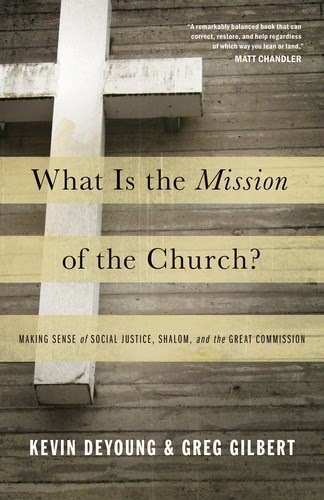
Book Review - What is the Mission of the Church?

There's quite a bit of debate around at the moment among Christians about what is meant by mission. On one side are positions like the Anglican 5 Marks of Mission:


The Mission of the Church is the mission of Christ:


  • To proclaim the Good News of the Kingdom
  • To teach, baptise and nurture new believers
  • To respond to human need by loving service
  • To seek to transform unjust structures of society, to challenge violence of every kind and to pursue peace and reconciliation
  • To strive to safeguard the integrity of creation and sustain and renew the life of the earth

source

Most official documents then include a comment like this (from the same page)

The first mark of mission... is really a summary of what all mission is about, because it is based on Jesus' own summary of his mission (Matthew 4:17, Mark 1:14-15, Luke 4:18, Luke 7:22; cf. John 3:14-17). Instead of being just one (albeit the first) of five distinct activities, this should be the key statement about everything we do in mission.

Comments like this are important but all too often ignored in practice by churches that (for example) adopt the UN Millennium Development Goals as their mission statement, or count their valuable work in running a recycling centre as mission.

DeYoung and Gilbert's book is the best statement I have come across of the other side of the debate. Here's a rough summary of what they say:

The Church's mission is summarised in the Great Commission – “to go into the world and make disciples by declaring the gospel of Jesus Christ in the power of the Spirit and gathering these disciples into churches, that they might worship the Lord and obey his commands now and in eternity to the glory of God the Father.” (p62)

The gospel is about the restoration of the whole of creation, but the centre of the gospel is the reconciliation of God and humanity brought about by forgiveness of sins through the death of Jesus. Being part of the kingdom of God requires acknowledging the kingship of Jesus – hence all gospel preaching demands response of repentance and faith.

We cannot build or grow God's kingdom – that is God's work and is never ascribed to people in Scripture. We are to bear witness to it – we are subjects and heralds of the kingdom, not its agents.

Biblical challenges to just living are about supporting those who cannot provide for themselves, treating the poor with dignity and not showing partiality to the rich, and not oppressing the poor by cheating them of promises payment. “If we truly believe the gospel of God's grace, we will be transformed to show grace to others in their time of need.” (p171)

“Social Justice” is a slippery phrase, but it's much clearer to talk about loving each other. Doing good to others and alleviating need is an opportunity for the church, not a responsibility to beat ourselves up over when we hear of injustice that we can do nothing about. “We really ought to love everyone, not all in the same way, but when we can, where we can, however we can.” (p193) “We are finite creatures and therefore it's important for us not to flog ourselves with undue guilt because we cannot show full, unbounded, active, suffering-relieving love to all seven billion people on the planet.” (p225)

The Biblical concept of “shalom” needs a lot more scholarly attention. There is both continuity and discontinuity between the Old Creation and the New Creation, but entrance into the New Creation is only through Jesus. Peace with God is the most important sort of peace, and so when we talk about seeking shalom for our communities, seeking peace between people and God has to be our top priority.

“It is not the church's responsibility to right every wrong or to meet every need, though we have Biblical motivation to do some of both. It is our responsibility however – our unique mission and plain priority – that this unpopular, impractical gospel message gets told, that neighbours and nations may know that Jesus is the Christ, the Son of God, and that by believing, they may have life in his name.” (p249)

In other words, DeYoung and Gilbert argue that the mission of the Church is not the same as the mission of God, because we are finite beings called by God to witness to what he has done, is doing and will do in Jesus. They also draw a distinction between the mission of the church and the good that Christians as individuals should do in the world when we have the opportunity to do so.

Why does this matter? Because what our mission is affects what our focus is. If the mission of the church is to evangelise and make disciples, that is what we should focus on. (Making disciples of course includes encouraging and equipping members of the church to live for God in the world.) But if the mission of the church is seen as including striving to safeguard the integrity of creation, then the church would look rather different.

My Response

I have to say, I found DeYoung and Gilbert's main idea persuasive and compelling. I think they did enough to establish what they set out to do. In particular, I liked their argument that we should see injustice as a potential opportunity for us to love others rather than as an area of responsibility which we should feel guilty over. It was immensely liberating, especially given the way that so many sessions on global justice issues often present it in a guilt-tripping sort of way.

The biggest weakness, I thought, concerned their discussion of whether the Western Church is currently unjust. They recognised the importance of justice at an individual level, but didn't consider the potential for structural injustice. It is quite possible that even though we as individuals might not be oppressing the poor or defrauding workers of their wages, we might well be participating in and supporting structures which do oppress the poor by keeping them poor and denying them opportunities which are offered to the rich. There's obviously a lot more work to be done on that, but it doesn't affect their overall argument.

I started this post by saying that there is quite a bit of debate around. Actually, there is nowhere near enough. Last year I went on a conference, organised by evangelical Anglicans, on the issue of Seeking Justice. I was hoping it would at least address the sort of question that DeYoung raises, but there wasn't even a seminar on it - the opposite view was everywhere assumed. For those in the UK, DeYoung is speaking on themes from his book at a conference on 31st January.

Tuesday, December 17, 2013

Did the "Carol Service" Census Really Happen?

If you ask an educated atheist to show that the events described in the New Testament didn't really happen, the number one place they pick is the "carol service" census described in Luke 2.

In those days Caesar Augustus issued a decree that a census should be taken of the entire Roman world. (This was the first census that took place while Quirinius was governor of Syria.) And everyone went to their own town to register. So Joseph also went up from the town of Nazareth in Galilee to Judea, to Bethlehem the town of David, because he belonged to the house and line of David. He went there to register with Mary, who was pledged to be married to him and was expecting a child.
Luke 2:1-5, NIV

Bock identifies five problems people cite when it comes to this passage.

  1. There was no known empire-wide census under Augustus
  2. No Roman census would have required Joseph to go to Bethlehem to register
  3. Israel under Herod wasn't officially part of the Roman Empire until Herod died in 4BC
  4. Josephus wrote that the first Roman census was under Quirinius in AD6, and that caused a revolt
  5. Quirinius wasn't governor of Syria until 10 years after Herod died. Herod died in 4BC, Quirinius became governor of Syria in AD6.

(It's worth noting in passing that pretty much everyone agrees Jesus was born in 5 or 6 BC - the chap who invented the BC/AD dating system guessed a date for Jesus' birth and got it close, but a few years out).

Some Answers...

Here are some answers to those problems, again adapted from Bock...

1) The Romans liked doing censuses because they liked taxing people. We know there was ongoing census activity across the Roman Empire at the time of Herod.

3) We also know that vassal kings (like Herod) did censuses too when Rome told them to. There's even evidence that Jews under Herod were paying Roman taxes (and hence had been censused).

If there was a census for Roman taxation and at Roman command under Herod, it makes sense that...

2 & 4) If Herod did a census (before 4BC), he might have done it Jewish-style rather than Roman-style. A Jewish-style census could well involve going to ancestral towns, especially if Joseph owned land in Bethlehem as he might well do if descended from David. Jewish land ownership was tied to who your ancestors were. A Jewish-style census wouldn't have caused riots like the Roman-style one in AD6 and so is less likely to be mentioned by Josephus, who is the only non-Biblical historian describing Palestine in that period.

It's also clear that the census Luke is talking about isn't the one in AD6. For example, a census after 4BC wouldn't have required Joseph to go from Nazareth to Bethlehem - after 4BC they were in different provinces. Luke also knows about the AD6 census - he mentions it and the rebellion in Acts 5:37.

So what about Quirinius? Luke 2:2 reads "This was the first census that took place whilea Quirinius was governor of Syria." But the NIV has a footnote saying “Or this census took place before...” The word in question is πρωτος (protos) - dictionaries define it as “first, before, greatest”. So it could be talking about the census BEFORE the one where Quirinius was governor of Syria (the one in AD6 which caused all the trouble). We've got the same issue in English with the word "prototype", which is from πρωτος. Was the prototype of the Jaguar XF the first one, or was it something they made before they made the XF?

Literally, the verse reads “this was the first census of Quirinius, governor of Syria.” Qurinius may well have been asked to administer the census by Herod, even though he wasn't governor of Syria yet. In the same way, we might say "President George W Bush was a notorious drunkard as a young man", even though he wasn't president when he was a young man.

In conclusion, it looks like the difficulties with these verses might well cancel out. There isn't enough historical evidence to say "these verses are definitely right", but there isn't enough evidence to say they're definitely wrong either. That's one of the problems with ancient history - we often don't have enough evidence to check whether written accounts are true or not. On the other hand, we do have that evidence to check lots of other things that Luke wrote, and he gets it right time after time, so chances are he's right this time too.

Incidentally, if this is the best the sceptics can do when it comes to attacking the reliability of the New Testament, what does that say about the rest of their arguments?

Wednesday, December 11, 2013

Book Review - Keith Lamdin, Finding Your Leadership Style

A diocesan-run course I'm doing asked us to read this book. I read it, found it very mixed, and so wrote this review, which the good folks at Themelios were kind enough to print. They made a couple of editorial changes for the primarily US market - here's my original version.

This book represents a unique convergence of influences. Lamdin writes as a liberal catholic Anglican in strong positive interaction with Willow Creek and the Global Leadership Summit (GLS) but also significantly influenced by Freudian psychology and liberation theology.

This convergence leads to some significant strengths. The GLS would benefit from more theological reflection on secular leadership models and much of the church would benefit from clearer thinking on leadership. Lamdin seeks to do both.

In chapters 1 and 2, Lamdin introduces the idea of leadership as “one human's capacity to influence another”, and the need for leadership within the church. He introduces three necessary qualities for leadership as discontent to see what is wrong with the present situation, vision to see how it could be better and courage to speak up and lead people forwards. He also introduces six “paradigms for leadership” which he unpacks in the rest of the book: the monarch, the warrior, the servant, the elder, the contemplative and the prophet.

The final chapter, entitled “Taking the Strain” shows a thoughtful engagement with both the traditions of Anglicanism and the business thinking so prevalent at the GLS – this time on how to do ministry in ways that are physically, emotionally and spiritually sustainable. This chapter could certainly be read with profit by many in ministry. It ends with a powerful picture of ministry as a craft skill – like carving or music, which comes naturally to some, but can always be learned and improved on; it can be mastered in several different ways but never perfected by us.
The largest and most problematic part of the book, however, is the central section, where Lamdin considers his six paradigms for leadership. He begins with the two paradigms he finds to be more common and more dangerous – the monarch and the warrior. The monarch is the leader who is in charge, leading to the possibility of safety, stability and effective organisation. The warrior is the charismatic leader of a cause with passion and purpose, sometimes leading to growth and huge achievement in an organisation. Lamdin argues that neither of these paradigms is appropriate for a Christian minister.
His reasons are both pragmatic and theological. Pragmatically, Lamdin argues that these forms of leadership always resort to force and end up infantilising the followers – either by taking away their ability to decide or their ability to discern right and wrong.

Theologically, Lamdin argues that Jesus rejects the roles of monarch and warrior, instead adopting the persona of suffering servant. But in doing so Lamdin makes a serious Christological mistake. He argues that God is fully revealed in the humanity of Christ, but restricts his view of Christ only to the crucifixion – Jesus is only suffering servant, not risen king. He sets this out most fully on p59 when discussing the idea of Jesus' dual identity as suffering servant and lord of history.

“It cannot be said that Jesus was enacting servanthood while on earth but that as Christ he is 'lord' of all he surveys. The Jesus on earth has to fully embody the godhead for any view of incarnation to be viable, and so the God of all time has to be understood in terms of the kingdom teaching and living and dying of Jesus... while it is in the nature of God to be loving it cannot be in the nature of God to be 'in charge'.”

Lamdin doesn't state whether or not he believes in the Resurrection. However, if we understand that God is fully revealed in Jesus, who is both the Suffering Servant and the risen and ascended King who “will return in glory to judge the living and the dead”, we get a rather different picture.

In this picture, it is inappropriate for us to adopt the role of warrior or monarch precisely because Jesus is our perfect warrior king. We should not act as if we are in control because God is in control. We should not go on a crusade against those we define as evil because it is for God to say what our purpose should be and who the enemy is (and our struggle is not against flesh and blood).
Lamdin then considers the other four paradigms for leadership. The key theme seems to be the relationship to power. The servant, obviously Lamdin's favourite, gives up power; the elder has only the power to ask questions and expose their own ignorance; the contemplative depends on God through prayer; the prophet stands against power with the downtrodden. None of them allows for a classic “church leader”; several have troubling features such as the absence of any sense of a “word from the Lord” speaking into our human situation to either resolve ambiguity (the elder) or confront injustice (the prophet).

But the understanding of Christ as risen and ascended Lord opens up a new paradigm – the paradigm of the herald or of the under-shepherd. Both heralds and under-shepherds have no authority in themselves and do not point to themselves as saviour. They are sent by a Shepherd-King and are answerable to him, but under him can and do have delegated authority for the purpose of caring for the sheep and serving them by proclaiming the king's message to them. It seems that would be an altogether more fruitful paradigm to explore.


Tuesday, December 03, 2013

More Book Reviews - Center Church / Preaching and Preachers / And the Lamb Wins

I don't post book reviews here often enough. So here are some quick reviews of three good books I've read recently.

Center Church - Timothy Keller

Keller (senior pastor of Redeemer Presbyterian, New York) is one of the most influential writers on theology and church at the moment, certainly in the Reformed world. And this is the closest he has come to a magnum opus. It's essentially a 400-odd page textbook on what it means to be and do church in the specific context of city-centre ministry in a global city. I'm not there, and I don't agree with Keller on everything, but if this was a course when I was at theological college, it would have been one of the best and most helpful courses on offer. He outlines different views on just about everything, shows where the tensions are, and usually shows how to plot a third way (or a fifth way) between them.

Genuinely helpful on big-picture stuff; really clearly laid out; genuinely brilliant. There's quite a bit of stuff that can't really be put into practice when you don't have a congregation of at least hundreds including talented artists (and there's not much on how to deal with having enthusiastic but not-talented amateurs), but there's lots of stuff that is helpful in my context and at painting a vision for why and how Redeemer has done what it's done, it's great.

Preaching and Preachers - Martyn Lloyd-Jones

The way I remember it, a few years ago someone did a survey of which books on preaching today's most respected preachers valued, and this one came top despite having been out of print for 20 years. So now it's back in print, sprinkled with essay-length commendations and appreciations from the likes of John Piper.

Martyn Lloyd-Jones's book was originally a series of lectures he gave on preaching in the late 60s, and the only book it really compares to is Spurgeon's Lectures to my Students. (For what it's worth, I'd rate Spurgeon slightly above P&P, but only slightly). Preachers & Preaching is like having a brilliant but utterly eccentric tutor. If you listen to him, you'll learn a lot, but some of what he says is quite batty. He has strong opinions on almost every imaginable topic, some of which are just odd (views on the shape of the roof of buildings and how it affects spiritual health of the congregation) and some of which are challenging and thought-provoking but probably wrong (why it is wrong to debate atheists).

I can see why so many great preachers value this book so highly though. It's really good, despite the quirky bits, and I've really been encouraged, challenged and built up by reading it! Strongly recommended...

And the Lamb Wins - Simon Ponsonby

This is a book-length version of Simon's St Aldate's School of Theology sessions on eschatology and the end times. It's clearly aimed at a bright undergraduate-level audience - he gives the histories of different theories on the millennium, for example. But if you can cope with that, it's very readable and a clear overview of a number of different aspects of end-times debate. He interacts with most of the main schools of thought, gives his own opinions and backs them up well. He probably succeeded in slightly changing my opinion on Israel, for example.

There are a couple of other areas I'd like to have seen him interact with - the nature of the final judgement for example, whether there is just one or two (works & faith?). But overall this is just about the best, sanest, most Biblically faithful handling of the end times I've read. I recently compared it with Randy Alcorn's Heaven, for example, and Alcorn is better on Heaven itself, but Ponsonby is clearer, more detailed and more rigorous in just about every other respect.