Saturday, March 25, 2006

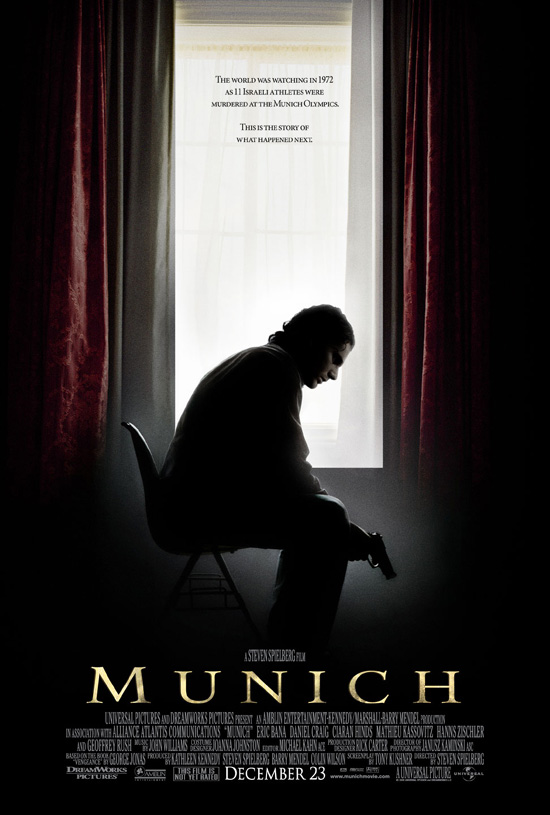
Munich

It's a few weeks since I saw the film, but think it's still worth saying a bit about it here.

The basic plot goes something like this...

In the aftermath of the 1972 Munich Olympics, Israel puts together a team of assassins to kill the people responsible, led by a soldier called Avner (Eric Bana).

As his mission progresses, he realises more and more that what he is doing only serves to escalate the violence. As his doubts about the legitimacy of the targets and the wisdom of that course of action as well as the danger to his team, himself and his family grow, he is forced to consider how to continue and as a result his loyalty to Israel is called into question.

In my opinion, a very good film about the dangers and problems inherent in the Israeli/Palenstinian situation and how violence rarely improves things. It says a lot about the state of things in the US that it's thought of as a liberal film there...

Again, a few questions to think about:

  • What would you have done in Avner's situation?
  • How does Spielberg's interpretation of events fit with verses such as Proverbs 15:1, 25:21 and Matthew 5:39?
  • Could there be Christian grounds for retaliation?
  • Why did Avner's handler act the way he did in the final scene? Was he right to do so? What does this have to teach us about relating to others?

Reviews

Here's a link to the movie reviews at Christianity Today. The series on "film and theology" from Mars Hill Church, Seattle is also excellent (and thanks to Ben for pointing that out). It's in Downloads | Classes | Film and Theology.

Tuesday, March 21, 2006

What is heaven?

Here's a shockingly powerful quote, quoted at challies.com.

The critical question for our generation--and for every generation--is this: If you could have heaven, with no sickness, and with all the friends you ever had on earth, and all the food you ever liked, and all the leisure activities you ever enjoyed, and all the natural beauties you ever say, all the physical pleasures you ever tasted, and no human conflict or any natural disasters, could you be satisfied with heaven, if Christ was not there?
John Piper, God is the Gospel

Sunday, March 19, 2006

V for Vendetta

I went to see a film the other day, and it got me thinking....

It's set in about 30 years' time, in the aftermath of the collapse of the USA stemming from their present war and bioterrorism. Britain (or the London area at any rate - that's where the film is all set) is ruled by a Nazi-style religious dictatorship. And yes, I know the Nazis were more Norse Pagan than Christian. This lot are never explicitly identified as Christian, but it's pretty obvious. Crimes punishable by death include homosexuality, owning a Qur'an, etc. The regime is of course hugely hypocritical - bishops who like small girls go completely unpunished and the police routinely rape women on the streets.

A masked "terrorist", known only as V, who has some pretty useful Matrix-esque skills, tries to overthrow the regime. He is variously helped by people including Natalie Portman, while the police inspector trying to catch them gradually uncovers more and more of the story behind the regime.

Hugo Weaving (Elrond, Agent Smith) does a great job of playing V, especially since he can't use his face to express himself. The film is generally good fun and well made, as well as being thought provoking. Here are a few questions to get you thinking if you've seen it:

  • Where should a Christian be in such a society?
  • Would you have joined the march on Parliament at the end?
  • How does the negative portrayal of Christianity latch on to popular misconceptions?
  • What can we be doing to deal with those misconceptions?
  • To what extent is V's reinterpretation Guy Fawkes legitimate?

IMDB page for the film

Saturday, March 11, 2006

Power and Jesus

I guess one of the key concepts in society at the moment is the concept of power. This is especially true when we are thinking about communication. The people who do the communicating have power over those to whom they communicate. They manipulate the information to their own ends and so cannot ultimately be trusted.

As I understand it, that's just basic pop postmodernism. Yet it's amazing to me that, while it is widely understood (though not perhaps widely articulated) in society, people seem to be surprised at the consequences. For example, it explains very well the disillusionment with politicians. If everyone is communicating primarily to gain or exercise power over you, then you cannot trust their information. Politicians cannot be trusted, though there still seems to be a residual (and inconsistent and unjustified) level of trust for the media.

This mistrust applies also when we try to communicate the Christian message. In my experience, people are happy to think about or talk about Jesus, or what Christianity means to me, or anything like that. But they are not happy and rapidly get uncomfortable if the conversation turns to them and Jesus' claims to authority over them. The obvious reason for this is that it has suddenly become personal - the stakes have been raised and what is said now might have a moral cost to them as well. After all,

The light has come into the world, and people loved the darkness rather than the light because their deeds were evil. For everyone who does wicked things hates the light and does not come to the light, lest his deeds should be exposed.
John 3:19-20, ESV

I'd like to suggest there might be another reason as well, one which is an unhelpful obstacle we put in people's way. When we start speaking about Jesus' authority over other people, we are implicitly making a claim to power over them. All of a sudden, instead of being their friend, we have become a politician - someone who is communicating with the aim of gaining power, and so therefore we can no longer be trusted. We are doing just the same thing as the world does.

One of the many great things about the Bible is that this is already dealt with. We can see, for example, how Jesus used his great authority over people.

[Jesus], though he was in the form of God, did not count equality with God a thing to be grasped, but made himself nothing, taking the form of a servant, being born in the likeness of men. And being found in human form, he humbled himself by becoming obedient to the point of death, even death on a cross.
Philippians 2:6-8, ESV

Jesus used his authority and his power to make himself nothing. He did the exact opposite of what so many in the world do. He communicted with us by becoming nothing. Amazingly counter-cultural and amazingly attractive.

We see something similar in Paul's approach to speaking about Jesus:

For what we proclaim is not ourselves, but Jesus Christ as Lord, with ourselves as your servants [δουλους - slaves] for Jesus' sake.
2 Corinthians 4:5, ESV

Paul's approach seems to be still to make the claims of Jesus' authority, but to do so being very very clear that he himself is not gaining power in this claim, but that he is a servant, even a slave, of the people to whom he is speaking.

I hope and pray that I will be enabled, by God's mighty power, to do the same.

Friday, March 03, 2006

TS Eliot - end of exploring

With the drawing of this Love and the voice of this Calling
We shall not cease from exploration
And the end of all our exploring
Will be to arrive where we started
And know the place for the first time.
TS Eliot, The Four Quartets

rest of poem

Monday, February 27, 2006

Carson - Hermenutical Constraints

One of the most important hermeneutical constraints one should adopt in order to avoid such reductionism is this: Permit the various attributes and characteristics of God to function in your theology only in the ways in which they function in Scripture; never permit them to function in your theology in such a way that the primary data, the data of Scripture, are contradicted. Thus one must not infer fatalism from the sweeping biblical data about God's sovereignty; one must not infer that God is finite from the constant biblical portrayal of God personally interacting with finite persons. From God's knowledge and sovereignty we must not justify prayerlessness; from the exhortations to pray and not give up, we must not suppose God is coerced by our much speaking (compare Matt. 6:7-8 and Luke 18:1). Precisely because God is so gloriously rich and complex a being, we must draw out the lessons the biblical writers draw out, and no others.
D.A. Carson

Saturday, February 25, 2006

Self-Acceptance

I'm just writing a short article about the area of self-worth and self-acceptance. A lot of my thinking on this springs from my own journey of self-acceptance and also my experiences of having a sister who struggled with anorexia for many years.

And I suppose in a way that's the best place to start, because it's one extreme view. One of the problems with anorexia is often that the person has or at least presents such a low view of their own worth that they want to starve themselves, harm themselves or even take their own lives.

We see the same kind of thing in a lesser form in a lot of other places. I know that one of the difficulties of being a teacher is helping pupils who have very little self-esteem achieve anything. Their lack of confidence in themselves can be paralysing.

And it's a problem society in general has latched onto as well. I'm sure if you go into most bookshops, you'd find books on how to build your self-esteem. And in my experience, the normal ways to try and build self-esteem are to base it in some way on who we are or on what we do. So people accept themselves – they think that they are worth something – based on their job, or their family, or their ethnicity, or their money, or their looks, or their sexual prowess or their fame or their fruitful ministry. They think that makes them worth something.

But at the end of the day, that doesn't work either, and I can see three main problems with it. The first is that it can lead to jealousy and dissatisfaction. You see, if I'm worth something because I'm clever, then surely if I meet someone who is more clever, then I'll think they are worth more than me. If I'm worth something because I'm popular, then that means celebrities are worth more than me. If I'm worth something because of wealth, then someone who is richer is worth more than me. And so we end up jealous of others. We end up idolising them, but secretly wanting to pull them down, so that we can be better than they are. We see it all the time.

Another problem is that it fails to cope with the reality that life isn't always easy. If I'm worth something because I'm a talented sportsman, then what happens after a car accident which leaves me in a wheelchair? What about Job?

But the biggest danger with basing our self-worth on who we are or what we do is that it leads to pride. If I'm worth something because I'm middle class English, what does that mean about those who aren't? Are they worth less? If I'm worth something because I'm wise or rich or strong, what does that mean about those who aren't? So if that's true then why shouldn't I boast? Surely if it makes me worth something, it's worth me boasting about!

But God brings low our pride, so that he alone will be exalted.

This is what the LORD says:
“Let not the wise boast in their wisdom or the strong boast in their strength or the rich boast in their riches, but let those who boast boast about this: that they understand and know me, that I am the LORD, who exercises kindness, justice and righteousness on earth, for in these things I delight,” declares the LORD.
Jeremiah 9:23, NRSV

Yet whatever gains I had, these I have come to regard as loss because of Christ. More than that, I regard everything as loss because of the surpassing value of knowing Christ Jesus my Lord. For his sake I have suffered the loss of all things and I regard them as rubbish in order that I may gain Christ and be found in him...
from Philippians 3, NRSV

What is it about me that is worth something? According to Jeremiah and to Paul, only the value of knowing God, in Christ Jesus my Lord. And that isn't because of something I've done. It's nothing to be credited to me. It is entirely because God is a gracious and compassionate God, slow to anger and abounding in love and faithfulness. It is because God the Father made me, because God the Son became a man and suffered and died for me, because God the Holy Spirit dwells in my heart and is bringing me into union with Christ.

Anything else I could trust in would fail me in the end, but God is my strength and my refuge. It is in him that I can accept myself, not because of anything I have done or can do, but because God loves me and has accepted me. And therefore, I should accept others because God has accepted them.
Monday, February 20, 2006

Prayer Request

Please pray for me over the next few days - interviews and stuff which could seriously affect the rest of my life.