Showing posts with label physics. Show all posts

Tuesday, June 03, 2014

Pet Peeves - Misusing "Quantum"

One thing which annoys me is when people who don't know what they're talking about abuse scientific language. One of the most egregious examples of this is the word "Quantum". It sounds cool, I know, but it really doesn't mean what most people seem to think it means.

This is what "Quantum" means:

Quantum: the smallest possible non-zero amount of something

It was actually quite a revolutionary idea to start with. There is a smallest possible amount of water - you can't take a jug of water and keep pouring half of it away - eventually you will end up with the smallest possible amount of water, and you either pour it all away or keep it all. Or I guess you could try splitting it and if you did it really cleverly you might end up with two beryllium hydride radicals which aren't water at all. Quantum is weird because we're used to the real world, where there are normally so many lumps of stuff that it looks smooth to us.

The same is true of pretty much anything - there's a smallest possible amount of light (one photon), of electric charge, of electricity, whatever. Maybe even of space, which I find quite weird as an idea. This leads to a couple of other common phrases:

Quantum Mechanics: the study of how quantum stuff behaves.

Quantum Leap: a jump between two states with no intermediate stages - i.e. the smallest possible change in something.

Quantum leaps can be big (I guess), just usually they're really small. A legitimate example would be to say that moving from DVD to Blu-Ray is a quantum leap, because there are no intermediate stages. But the fact it's a quantum leap doesn't imply anything about the size or the significance, just that there's no intermediate step. "On the 100-question multiple choice physics exam, Tony went from 35% to 36%. That's a quantum leap.

Misusing the word "quantum" is like claiming that Shakespeare was a great novelist. It's a basic error which just makes people look stupid.

Examples

Quantum of the Seas is a boat. Its name means "smallest possible amount of the seas", and it claims to be the smallest possible step forwards from its predecessors. On that basis, I wouldn't bother.

Almost every single use of the word "quantum" in relation to the social sciences or arts subjects I've read has demonstrated major misunderstandings - even C.S. Lewis in Miracles. The big exceptions are when the author themselves has a masters or better in physics - e.g. John Polkinghorne.

Quantum of Solace is a film. I think they actually got the title about right - it's like a crumb of solace only much much smaller as Bond continues the transformation from hard man to killer to utterly ruthless and remorseless suave super-agent.

Quantum Leap can be forgiven just about anything.


Friday, September 03, 2010

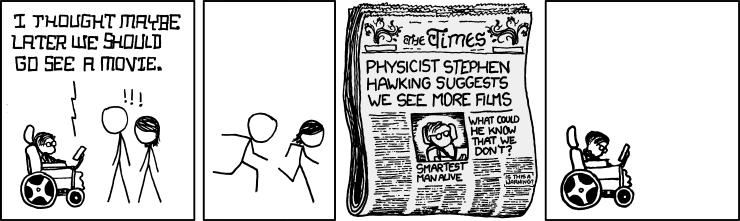
God, Stephen Hawking and the BBC

The currently most-read article on the BBC website has this headline "Stephen Hawking: God did not create Universe". As a Christian who has studied a fair bit of physics, I'm going to discuss that. Quick summary of my conclusions: Hawking has got it a bit wrong, but the media are over-sensationalising it as usual. And in the process, they are providing a massive amount of free advertising for Hawking's new book.

It's worth pointing out that I haven't read Hawking's article, because it's behind the Times' paywall, or Hawking's book, because it hasn't been published yet. But at this stage of his career, Hawking is far more a populariser of ideas than an original thinker, so I've got a pretty good idea where he is coming from on this...

The BBC quotes Hawking as writing:

Because there is a law such as gravity, the universe can and will create itself from nothing.

Spontaneous creation is the reason there is something rather than nothing, why the universe exists, why we exist.

It is not necessary to invoke God to light the blue touch paper and set the universe going.

Science and Religion

It's worth explaining a few things from these quotes. Firstly, Hawking's philosophy of how God acts in the universe. Hawking seems to have a kind of "God of the gaps" idea going on here - he only sees it as "necessary to invoke God" when there is no other explanation for something.

Of course, Hawking isn't stupid enough to go down the classic God of the Gaps line. He'd probably draw a distinction between when it is "necessary to invoke God" - i.e. when there is no other explanation for something, and when it is possible to invoke God - i.e. when there is an explanation for something that includes the possibility that God is behind it. The Christian answer - that science describes the way that God chooses to run the world - would be treated as when it is possible to invoke God rather than when it is necessary to do so.

Hawking is still wrong though. Rowan Williams is better (quoted on the front of the Times Online today):

Belief in God is not about plugging a gap in explaining how one thing relates to another within the Universe. It is the belief that there is an intelligent, living agent on whose activity everything ultimately depends for its existence.

In other words, Rowan Williams (correctly IMO) asserts that God's existence and action is necessary for science to keep working at all. God and Science aren't competing explanations for the same phenomenon.

Of course, the journalists seem to have even less understanding of this, and think that because Hawking says it isn't necessary to invoke God, he's denying God was involved at all. That's partly because it sells more papers or gets more people looking at the website, and partly because they don't have sufficient understanding of the topic to report accurately on it.

Creation and Quantum Fluctuations

The other thing that is worth explaining is what it means for Hawking to write that "Because there is a law such as gravity, the universe can and will create itself from nothing."

In quantum physics, things do sometimes just appear out of nowhere, and then vanish again. But when they do, the total amount of energy involved multiplied by the time they last for has to be less than about 10^-34 Js. So an electron / positron pair, for example, could only last about 10^-21s - one thousand billion billionth of a second. And something bigger would last even less long. So we don't see them very often and they don't usually make much difference to the universe on a big scale.

But that is the only known way of getting something out of nothing. So if the universe wasn't created - it just happened - that's the only known way for it to happen. The problem with that of course is that the universe has lasted quite a while - roughly 14 billion years. Therefore, in order for this theory to work, it needs to have almost exactly zero total energy.

The only known way of having a sufficiently large amount of "negative energy" is through gravity. Imagine that there is a lump of rock a very long way from the Sun, and it isn't moving. Now imagine that it falls towards the Sun, and in doing so it speeds up. It has clearly gained kinetic energy because it is moving. At a year 7 level, we'd say it has converted Gravitational Potential Energy (GPE) to Kinetic Energy (KE). But at the start, its total energy was zero, and at the end its KE is positive, therefore its GPE must be negative.

It's often asserted in astrophysics circles that Black Holes have zero total energy, because all the negative GPE cancels out the positive energy from their mass. And therefore it is possible to get something out of nothing if the something is a black hole because it has zero total energy. On the other hand, I've done a masters course in astrophysics, and I've never once seen that calculation done, or even referenced. Personally, I don't believe it, and I believe it even less when it comes to saying the universe as a whole has zero total energy, but am happy to change my mind if given a good reference that doesn't just assert it.

If it was true, it should mean that you get black holes popping into existence and staying there quite often, and we don't see that happening.

But the idea here is that many cosmologists think that that is what happened with the universe - it popped into existence as a kind of unstable black hole with zero total energy that then exploded. And that's what Hawking means by saying that gravity allows the creation of something from nothing.

(Images from NASA)

Thursday, June 11, 2009

Pointless Scaremongering...

There's an interesting story here. It's true that the orbits of planets in the Solar System aren't quite stable - they're just pretty stable, but that's good enough for us. So I suppose that it is possible that Mars might collide with Earth in about 3 billion years.

But let's get a bit of perspective. According to evolutionary biologists, the most complex organisms alive 3 billion years ago were single-celled organisms too small to see with the naked eye. What people would be like in 3 billion years time is an interesting question, but it's pretty likely we wouldn't be much like we are today. The total of recorded human history is about 10,000 years or so, before which time (if we existed at all), we were living in caves and hitting things with sharp rocks. 1 billion years is 100,000 times as long as that. So the whole of human history, back to back and left to run for 300,000 times. That's how long 3 billion years is.

But that's not the point either. Because even if Jesus hasn't come back by then, our understanding of how stars work suggests that the Sun will by that stage be a fair bit warmer. So much warmer in fact, that many predict that by then the Earth will be too hot to have important things like liquid water on the surface and we'll all be dead anyway, unless we've invented some clever spaceships or something.

This page, for instance, suggests "the end of large surface life on Earth" in about 1.1 billion years due to how the Sun is expected to change with time.

So given that, I don't think that we need worry too much about being crashed into by Mars another 1.9 billion years after the Earth has become uninhabitable.

Monday, April 20, 2009

The Great Contrail Controversy

Back when I was studying physics, there was a big controversy about contrails - those white lines that aeroplanes leave behind them in the skies. It might have been sorted out now; I'm not sure, but I do think I know the answer.

There were two main schools of thought when I was studying physics. One school of thought said that they were caused by the engines - the air coming out of aircraft engines has more water vapour than the air going into them (because burning fuel creates carbon dioxide and water) and therefore the contrails were that water vapour condensing behind the aircraft. The problem with this is that some aeroplanes have three engines - one on each wing and one on the back, and they don't seem to leave three-lined contrails.

The other school of thought was that because air goes faster over the top of the wing than the bottom of the wing, the aircraft moving through the air creates vortex strings behind it, and water vapour in the air condenses onto them. The problem with this is that it's not immediately obvious that it works as an idea...

I was flying back from Rome a while ago, and I noticed contrails forming behind the aeroplane, and I noticed where they were coming from. On the back surface of the wing, there are flaps. And when the flaps are lowered, this creates a jagged back surface to the wing, as if some bits were missing. The contrails were forming from the edge of those jagged bits - they're created by turbulence from air coming off the back of the wing where the wing is uneven because of flaps.

That's what caused these anyway...

Thursday, December 11, 2008

Optical Illusions

There are some great optical illusions here. I used quite a few of them when I was teaching A-level physics. It's a great reminder that we actually do a lot of processing between our eyes and the bit of the brain that thinks it's seeing.

In this image, squares A and B are actually the same colour; our brain just processes them differently - it often took using a computer graphics program to move them next to each other to convince people it really worked.

This image is actually static. Lots of people see that it's moving, and which bits are moving keeps changing. It's actually because of how our eyes focus - the bits at the edge aren't in exactly the right position, and also our eyes tend to be drawn to movement, which means that when we focus on one bit, the other bits look like they move as which bit of our eye we are using to focus on them changes.

From a spiritual point of view, they are also great reminders that what we see isn't the ultimate level of reality, because Jesus has been raised from the dead, which means that the "real us" is who we will be one day when we too have been raised from the dead, which changes our perspective on suffering in this life and so on.

For our light and momentary troubles are achieving for us an eternal glory that far outweighs them all. So we fix our eyes not on what is seen, but on what is unseen. For what is seen is temporary, but what is unseen is eternal.

Now we know that if the earthly tent we live in is destroyed, we have a building from God, an eternal house in heaven, not built by human hands. Meanwhile we groan, longing to be clothed with our heavenly dwelling, because when we are clothed, we will not be found naked. For while we are in this tent, we groan and are burdened, because we do not wish to be unclothed but to be clothed with our heavenly dwelling, so that what is mortal may be swallowed up by life. Now it is God who has made us for this very purpose and has given us the Spirit as a deposit, guaranteeing what is to come.

Therefore we are always confident and know that as long as we are at home in the body we are away from the Lord. We live by faith, not by sight.

2 Corinthians 4:17-5:7, NIV

Wednesday, December 03, 2008

Head First Physics

Head First Physics is a physics textbook written by a friend of mine.

It's a really helpful way into thinking about mechanics (and it is pretty much all mechanics), especially for people who aren't that good at maths. It's aimed at an American audience, but it covers mechanics roughly up to the British A-level.

Amusingly, the first and last words in the book are by me! Here they are:

If you want to learn some Physics, but you think it's too difficult, buy this book! It will probably help, and if it doesn't, you can always use it as a doorstop or hamster bedding or something.

This is a truly remarkable book. The physics is taught clearly and without too much mathematics by looking at a series of well-chosen real-life or comedy tasks. If math really doesn't turn you on, this is a great way to learn Physics! I didn't think it was possible to do some of this stuff without calculus, but Head First Physics has done it.

Wednesday, September 10, 2008

CERN Rap

Ah, this brings back so many memories. If I was still teaching, I'd make the upper 6th kids watch this...

Monday, May 12, 2008

Einstein on Jesus

I am a Jew, but I am enthralled by the luminous figure of the Nazarene... No one can read the Gospels without feeling the actual presence of Jesus. His personality pulsates in every word. No myth is filled with such life.

Albert Einstein, 1929

Tuesday, April 15, 2008

John Wheeler

John Wheeler has died. To my mind, he was the last of the really great physicists. Whether there will be any more is an interesting question.

Wednesday, March 19, 2008

Arthur C. Clarke

Arthur C. Clarke has died. He was one of my favourite writers when I was a teenager, and had the great strength that most of his science made sense - he was for a long time more of a visionary populariser of science who could write than an author who liked science.

He'll pretty much always be credited with inventing the communications satellite. Actually, as I remember, he just popularised the idea which was already hiding in some obscure scientific literature.

He probably stands out to me as someone who was excellent at popularising and motivating people to love physics. He'll be missed.

Thursday, February 21, 2008

Great Bit of Materials Science

I really like this story on the BBC website, because it's a lovely bit of science. There's a solid that's made of small molecules with lots of hydrogen bonds, which means the molecules hold together well, and if you break it apart, it will stick back together really easily of its own accord.

The obvious problem is water - water sticks to hydrogen bonds very well, so there might be issues if it breaks then gets wet. It would be very hard to dry, and the water might muck up the resticking ability. But there might be ways round that, and it's a very very nice idea.

Thursday, February 07, 2008

Philosophy of Time Travel and Terry Practchett

One of the areas I used to be really interested in was the philosophy of time travel as represented in science fiction, especially with what happens if you change your own past, and how that ties into possible physical models of the universe. So there's the Back to the Future model, the Terminator model, the Quantum Leap model, the Sliders model, and so on. The problem if we ever do manage to travel backwards in time is knowing which model actually works. Maybe I'll write more on that at some point.

Anyway, here's a funny quote from Terry Pratchett, messing around with the idea in The Last Continent:

"I can't help thinking, though, that we may have... tinkered with the past, Archchancellor," said the Senior Wrangler.

"I don't see how," said Ridcully. "After all, the past happened before we got here."

"Yes, but now we're here, we've changed it."

"Then we changed it before."

And that, they felt, pretty well summed it up. It is very easy to get ridiculously confused about the tenses of time travel, but most things can be resolved by a sufficiently large ego.

Friday, January 25, 2008

General Revelation

I've had to do quite a bit of reading recently on the idea of General Revelation and Natural Theology - basically what we can tell about God from looking at the world around us.

I still think Calvin's treatment of it is about as good as they come. He points out that we should be able to tell lots about God from creation, but that we can't see all of it, and we often get bits wrong because we're sinful and blind, and because the blindness and the sinfulness are linked, it's our fault that we don't see God more clearly in the world.

What's interesting though is seeing what the Bible tells us we should be able to tell about God from the world around us.

  • That God is real
  • That God is powerful beyond our understanding (e.g. Job 38)
  • That God is wise beyond our understanding (e.g. Isaiah 55:8-9)
  • That God is reliable (e.g. Jeremiah 33:25-26)
  • That we should obey God (e.g. Jeremiah 8:7-9, 18:13-15)
  • That God is patient

In other words, what we should be able to know about God from the world around us isn't enough that we can be saved. But it is enough that we should be able to see that we desperately need saving, and that we can trust God to do it. It's enough to point us to Jesus, but not enough to replace him.

Being able to see God in the universe doesn't mean that we have authority or power over God - it's because he graciously made us as human beings and made the universe in such a way that we could tell a bit about him from it.

Those things we can tell about God from the universe actually sum up lots of the reasons I enjoyed studying physics so much...

I could put in lots of stuff here about the Barth / Brunner debate, but I can't be bothered, and I don't think it would help that much.

Friday, January 04, 2008

Obscurantism and Meaninglessness

If then I do not grasp the meaning of what someone is saying, I am a foreigner to the speaker, and he is a foreigner to me.
1 Corinthians 14:11, NIV

I thought it was worth doing a post on one of the great landmark papers in the history of science and philosophy - the well-named Transgressing the Boundaries - Towards a Transformative Hermeneutics of Quantum Gravity. It was written by Alan Sokal, Professor of Physics at New York University. Sokal comments on it here.

The paper is especially notable, because it was deliberately written as a load of rubbish and was submitted to and accepted by a peer-reviewed journal. Sokal himself wrote of it:

Nowhere in all of this is there anything resembling a logical sequence of thought; one finds only citations of authority, plays on words, strained analogies, and bald assertions.

And it was accepted by a peer-reviewed academic journal. My point is this:

Rule 1 - If someone is not clear in what they are saying, it is quite possible that what they are saying is actually a load of rubbish.

Rule 2 - If we are not clear in what we are saying, there is a high chance of everyone else writing it off as a load of rubbish.

But then again, they might think it's really clever. But it's better to be understood and disagreed with than to have people think you're clever. If Rule 1 was more widely appreciated, it would help clarity of communication greatly.

Tuesday, November 27, 2007

Wow - Botafumeiro

I saw this video this morning on the Bishop of Buckingham's Blog, and was somewhat amazed. It's at the Cathedral of Santiago de Compostela (supposed burial place of Jesus' brother, in Spain).

The physics is somewhat cool - it's a pendulum, and you can see the rope-pullers pulling in phase with the pendulum swing, hence adding in energy at a frequency which the pendulum can't lose easily, which means it swings more and more.

Plenty of other random thoughts too though:

  • health and safety... Apparently in 1499, it came off the rope and flew through a high window in the cathedral. But that's about the size and weight of a person - how much damage could it do if the rope broke? (Geeky note - the tension in the rope is highest at the bottom of the swing) Or if someone got in the way?
  • Distraction from the service - like anyone is going to be paying any attention to anything else...
  • How do the rope-pullers keep breathing with that much incense around them?
  • I'm really not a fan of applause in church
  • I think the whole thing seems to detract from the point of incense. As Catholic friends have explained it, incense is about emphasising God's transcendence through production of CO, impairment of vision, strong aromatic odour, etc. But all it would do in that context would be reminding you of how nifty and whatever the botafumey thing was.

Friday, October 19, 2007

Climate Change, Global Warming, etc.

I used to be a physicist. I even used to be pretty good at Physics. I sometimes therefore get asked my opinion on climate change. This is roughly it.

One of the more difficult bits of physics is the study of complex systems, of which global climate is undoubtedly one - in fact a lot of the field was invented as a result of research by a weather forecaster called Lorenz, who found that if he changed the numbers he put into his computer simulation very very slightly, it gave a big difference in the results, which was famously explained as a butterfly flapping its wings in Asia being able to affect the course of a hurricane in the Atlantic. (The impression I get is that modern weather forecasting still hasn't really caught up with it - what they should do is put in a range of different scenarios which fit the available data, parallel process them and then come out with statistical results like "70% chance of rain" and not claim to know the shape of the clouds or whatever. My friend Chris, who is a weather forecaster, may of course correct me on this...). Basically, the upshot is that if anyone says they know what is going to happen with the weather, they're way too confident.

Anyhow, one shape that keeps coming up in the study of complex systems is the Lorenz Attractor. Basically, it seems to be good at describing how these systems work, and it's a pretty good guess to say that the global weather system will follow some kind of multi-dimensional Lorenz attractor. Features of the Lorenz Attractor are roughly as follows:

  • Generally, systems appear to stay stable
  • Every so often, but it's pretty much impossible to predict when, the system will "flip" to a different sort of stable. This flipping might take a long time, or it might be quite quick. In very complex systems, like global weather, they may be a very large number of different possible fairly stable states, so it's almost impossible to predict exactly what it will flip to.
  • A slight change in initial conditions can make a big difference to how long a system takes to flip, or which direction it flips in.

We can apply this to the global climate:

  • The global climate appears to have been fairly stable over the last 100 years or so
  • It appears to be less stable now
  • Over the last 150 years, we have put large quantities of carbon dioxide, heat, etc into the atmosphere.
  • If the climate is flipping now, it is impossible to say for sure whether it is due to human activity, but it seems likely that human activity is at least a factor.
  • We can't know precisely what the global climate will flip to
  • We're used to the climate the way it was. Cities are built assuming the shoreline is where it was, agriculture assumes the climate was the way it was, etc. Any big change in climate is therefore going to be very disruptive and cause a lot of suffering, especially to the poor, because they're always the ones who get it.
  • Because it is virtually impossible to do accurate long term predictions, it is very difficult to know exactly what to do about it. Would reducing the carbon dioxide emissions stop the current changes? If anyone says they know the answer to that one, they're far too confident.

Tuesday, October 02, 2007

Candles

Candles are great for helping people to relax and for helping people achieve ecstatic experiences (trances, etc).

I reckon it's because of all the carbon monoxide they produce.


Seriously, the yellow flame means there's incomplete combustion of carbon, producing carbon monoxide, which latches onto red blood cells, preventing them from carrying oxygen to the brain. Complete combustion gives a blue flame, producing carbon dioxide.

Sunday, July 15, 2007

Bill Bryson - A Short History of Nearly Everything

This is just about the best introduction to science generally for non-scientists that I've ever read.

Bill Bryson manages to cover topics such as cosmology, geophysics, astrophysics, very basic chemistry and atomic physics, paleontology and evolutionary biology, all from the point of view of how they were discovered, thought of or argued about, and always focusing on the interesting characters involved as much as the science. He is refreshing in his honesty sometimes. Yes, it's only a basic introduction, yes, he makes a couple of mistakes, but I still learnt stuff about some of the characters and arguments involved in the history of science.

If you want something heavier, Gribbin's History of Science is much more thorough and a good read. If you want something more fun and interesting, this is great.