Showing posts with label me. Show all posts

Tuesday, November 05, 2013

Rule of Life?

For a long time I have mistrusted the idea of a “rule of life”. It all sounded terribly... legalistic – the kind of thing that was externally imposed on someone as yet more man-made rules they had to keep before a church which had grossly misunderstood God would allow them into heaven, or something like that.

But over the last year or so, something like the idea of a “rule of life” has come at me from several angles. Here's Martyn Lloyd-Jones, for example.

... the question of discipline is thrown right back on the [preacher] himself. Nobody can tell him what to do. What controls everything is his realisation that if he is to be what he should be, if he is to be a true preacher, a spiritually minded man who is concerned about ministering to the glory of God and the edification and salvation of souls, he must do this. That should compel him to exercise this discipline. If he has the right motive and the right objective, if he is truly called, he will be so anxious to do all he has to do in the most effective manner that he will take the trouble to find out how best to order and organise himself and his day.
Preaching and Preachers, ch 9 (sic)

Or here's James Emery White:

This is what a “rule” is – a collected, organized set of practices we determine to follow in order to tend to our spirits and shepherd our souls. We need structure and discipline for our spiritual lives every bit as much as we do for every other area of life.

Whatever our “rule” may be, it can, and should, be natural to our personality and developed in light of our season of life – but it must be created. If we know that we would be profoundly served by reading, praying, and spending time with a soul friend, then we must work toward establishing the patterns of life that allow it.

Several times, the phrase “rule of life” has come up in that sort of context and in the longer and better ones (e.g. Finding a Personal Rule of Life by Harold Millar) they tend to explain it roughly as follows:

“Rule” is a translation of the Latin “regula”, which has the sense of a standard or a pattern as well as a rule – regularity rather than regulations (both come from the same Latin word). So a “rule of life” is not something external and imposed on us – it is a pattern of life that we decide to stick to because it is good for us and enables us to live at our best.
(wording my own)

My response to that is simple. If that's what you mean by the phrase “rule of life”, then wouldn't it be better to call it a “pattern for living”? That also has the nice ambiguity that it's a pattern by which I decide to live which then enables me to really live.

And with that overly-pedantic improvement made, it sounds important to do, great to put into practice and I've written one!

(that's me "really living"...)

Tuesday, September 17, 2013

Knowledge, Quizzes and Knowing God

“Knowledge puffs up but love builds up”

I'm a bit of a geek for facts, especially Bible facts. When I was 6 or 7, my school teacher asked which king was killed by an arrow to the eye. I answered “Josiah”, because my cartoon Bible had Josiah being shot in the eye with an arrow. The actual Bible says that Josiah was shot with an arrow (2 Chron 35:23), but doesn't say he was shot in the eye. Then again, no contemporary accounts say King Harold II Godwinson was shot in the eye either.

For years, my knowledge held me back from knowing God. I thought that because I knew lots of stuff about God that I actually knew him. Head knowledge is not a substitute for relationship.

Head knowledge can also get in the way when it leads to pride or when we start finding our identity or our sense of self-worth in what we know rather than in the fact we are known and accepted by God.

But in its right place, knowledge can be useful – even geeky Bible trivia. Knowing which order events occur in in the gospel of Mark, for example, helps you see how the story fits together which helps you understand better some of the significance of the individual events. Or knowing small details in one story helps you see resonances and connections with other, seemingly unconnected stories.

One of the best ways I've found of learning facts, especially for people like me, is quizzes. There's nothing quite like an internet quiz for helping me to learn (say) the capitals of Caribbean countries. So here are some helpful internet quizzes I've found for getting to know Bible facts:

Books of the Bible: OT | NT | all.

OT events | Psalm 23 | Bible quotes

Bible events in order (tricky)

Monday, January 07, 2013

Prayer Request

I know I don't usually post prayer requests on here, but tomorrow I'm due to be doing a radio debate with an atheist called Justin Schieber on the Amalekite Genocide of 1 Samuel 15. Please pray for me.

I'll post some more stuff for discussion up here over the next few days, and a link to the recording of the debate when it's available. For the meantime, here's a link to some of my past stuff on the Amalekites. I've moved on a bit since then though...

Monday, November 16, 2009

Am I a Conservative Evangelical?

It isn't the sort of question that keeps me awake at night. But it's something I think about occasionally...

It's easy to say that I used to be. 5 years ago I was involved in lay leadership in a conservative evangelical church, going to conservative evangelical camps and conferences and so on and agreeing with most of what was being said, and reading mostly conservative evangelical books. I criticised mainstream conservative evangelicalism on issues like their failure to communicate the primacy of grace when discussing homosexuality, but I did so from within the movement.

But am I still one? My context has certainly changed - I'm now an ordained minister in a charismatic evangelical church and while I still go to some conservative evangelical events, I probably go to more charismatic evangelical ones and read quite a lot of books from both charismatic and open evangelical perspectives. And I seem to fit the label "conservamatic" fairly well, though I'm a lot more comfortable in high church settings than most conservatives or charismatics, and don't like being defined as fitting into any one group.

The thing is, my theology hasn't changed much at all. There are quite a lot of areas where my understanding has deepened or clarified, but I don't think my theology has moved much. The big things that have changed which affect whether I'm a conservative evangelical or not, as far as I can tell, are:

  • I've realised that conservative evangelicals often emphasise and word things in reaction against points of view they've come into conflict with - especially Ryle's caricature of 16th century Roman Catholicism, modernist liberalism, postmodern syncretism and pentecostalism.
  • I've realised that there are a good number of charismatics who don't fall into the traps which I used to associate with them, and that a lot of them don't mean what I thought they meant in the way they talk about the Holy Spirit. Many of them also seem to use the ecstatic gifts (which I never really thought had ceased) sensibly rather than just ignoring them as the conservative evangelicals did.
  • I think I understand much better how it is quite possible to be a sincere and Bible-believing Christian and to be a convinced charismatic (like my training incumbent) or anglo-catholic (like the local suffregan bishop), and I'm happy getting along with such people and even being a regular member of their churches. I think there are much more important issues than church politics, such as love for God and others, mission and evangelism, and so on.
  • Conservative evangelical culture has solidified a bit more and moved slightly, and I'm not hanging around with them as much.

Having thought about it a bit, I think I'm happy and comfortable being a conservative evangelical (albeit one with charismatic leanings and some catholic sympathies) when I hang around with conservative evangelicals. And when I hang around with charismatics, I'm happy being a charismatic with strong Biblical tendancies and conservative influences. When I hang out with open evangelicals, I'm happy fitting in at the more conservative end of open evangelicalism unless they start conservative-bashing. And when I hang around with wider groups, I'm happy not really fitting any label well but saying controversial stuff and trying to mix up the stupor that seems to hang over such gatherings. And I think and find it is quite possible to be all of those without inconsistency.

Wednesday, July 01, 2009

Apologies

Sorry for the lack of posts at the moment. I've moved house and don't currently have internet access. This should hopefully change before too long!

Thursday, June 25, 2009

Tuesday, January 13, 2009

Letting Go...

The other day, at dinner, I was chatting to a couple of my good friends, from different churchy backgrounds to me. We all admitted that there had been times in the last few years when we had faced a difficult decision. We had to choose to be willing to let go of our backgrounds (in my case conservative evangelicalism), and whether others would think us "sound" or whatever, and be willing to follow Jesus and the truth, wherever it went, even if it went to liberal catholicism (for example).

None of us had moved much as a result of letting go, but we'd all moved to nearly the same place. And we all strongly identified with the tradition we'd come from (conservative evangelical, charismatic, etc), but often now found ourselves often on the outside of it. As a friend of mine put it, he often finds himself falling between several stools. And as I responded, that's a lot better than landing directly in the poo.

Thursday, December 04, 2008

Typealyzer

According to Typealyzer (for which thanks to Bishop Alan, my blog suggests it is written in the style of a Myers-Briggs INTP. This is comforting, as I am an INTP, and like it that way.

The logical and analytical type. They are especialy attuned to difficult creative and intellectual challenges and always look for something more complex to dig into. They are great at finding subtle connections between things and imagine far-reaching implications.

They enjoy working with complex things using a lot of concepts and imaginative models of reality. Since they are not very good at seeing and understanding the needs of other people, they might come across as arrogant, impatient and insensitive to people that need some time to understand what they are talking about.


What is concerning to me is a) that they seem to have mis-spelt especially and b) that the person in the picture is clearly using a Mac, which I don't like as I find them harder to reconfigure...

Thursday, August 07, 2008

Public Thanks

As regular readers of this blog will know, I sat some rather horrible exams recently. As some people will know, I ended up doing rather well in them, graca de Deus. Given how difficult I found some of the papers, and given the fact I'd been working for two years aiming to learn stuff for ministry not stuff for exams, it came as a huge surprise to me to end up winning one of the University prizes.

In fact, the Wycliffe contingent in the exams did rather well overall. We ended up having three people in the top 5 in the university at Theology. I'd therefore like to take the opportunity to publicly thank some of the people who helped a lot.

Foremost among these is Peter Southwell, legendary (and now sadly retired) Senior Tutor at Wycliffe, and in charge of the course, as well as tutoring large chunks of it. Another special mention should go to David Wenham for helping us to see what a godly, humble and profoundly evangelical approach to Scripture looks like. Also to my other great tutors - Nick King, Michael Steenberg, Charlotte Methuen, Benno van den Torren, John Muddiman and Peter Harrison - many thanks.

To God alone be the glory!

Tuesday, July 08, 2008

Prince Caspian and the next few weeks

Last night, I saw Prince Caspian at the cinema. I have to say - I think it was a lot better than the first film, and even better than the book of Prince Caspian. They've expanded the story in several ways, most of which are improvements and which bring out the points more clearly or nuances in the characters. For me, the only thing that didn't work was the whole Susan / Caspian subplot.

Having said that briefly, I'm about to go off on placement until late August. I don't know how much I'll be able to post (if at all). So don't worry if nothing much new appears here.

Thursday, May 08, 2008

Filling in Forms

For some reason, some sensible filling of a stupid form by an architect has made the news. You can see the full form here.

It just seems the sensible thing to do, though the fact I'm prone to do that sort of thing quite a bit has on occasion got me into trouble. I remember filling in a risk assessment form for a school trip I was running, and including an assessment of the risk of alien abduction or nuclear war. The headmaster of course returned the form to me (with approval) pointing out that I hadn't done an assessment for an outbreak of some obscure disease.

But the time I really got some hassle was when applying for something with an organisation which I'm not going to name, but which might well rhyme with "Birch of England". This particular application seemed to filter people on the basis of their ability and liking for vast quantities of over-repetitive paperwork. So after the first two or three times of filling in personal details, I started inventing fictional children of mine with implausible Biblical names. And then came the medical form, which got unduly obtrusive about medical history of friends, relations, pets, etc.

One of the questions asked if I had restricted mobility. Now, I like clear communication, and I like avoiding jargon. And I know that "restricted mobility" is, in the way it is normally used, politically correct medical jargon for what would normally be called "physical disability". But it's actually a really stupid phrase, because "unrestricted mobility" is something that no-one has. But they didn't give me enough space to write all this, so I just commented that I couldn't fly unaided.

And a few weeks later, I got a phone call from an elderly gentleman with no sense of humour whatsoever who didn't seem able to understand that the words on the form could mean anything other than their jargon meaning. Oh well....

Wednesday, February 20, 2008

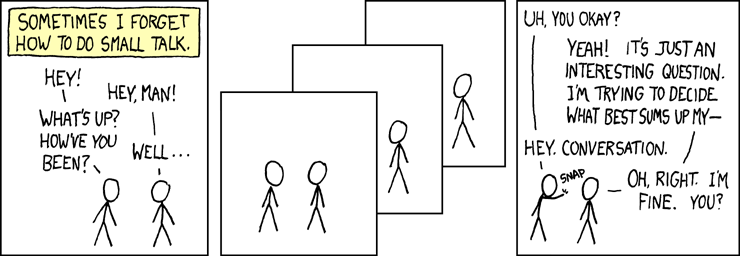
Small Talk

Beauty and creativity are good, but I'm still a geek.

(from the great and ever-so-useful-in-quizzes xkcd)

Friday, February 01, 2008

Helicopters

Suggestion:

With the exception of emergency services, helicopters should not be allowed to fly over built-up areas, especially at night.

And this post might in some way be linked to the difficulty I had in getting to sleep last night...

Tuesday, January 29, 2008

A Great Birthday Present!

A couple of months ago now, it was my birthday. One of the presents I was given was a copy of the whole ESV being read out in MP3 format. It was a great present.

I do quite a bit of driving. My placement next year, for example, is over 30 mins away by car. It takes 2½ hours to drive to my parents' place. And having the Bible on MP3 means that I can spend a good fraction of that time listening to the Bible.

It makes getting a big picture of books and so on much easier. It makes revising for my Bible exams much easier. It makes studying the Bible while I'm running or walking or something much easier.

So thanks again!

Sunday, January 20, 2008

Random Thoughts

I was in a supermarket the other day, and was disturbed by just how much more space is given to fizzy drinks than to fruit juice. I mean - who drinks more fizzy than fruit juice anyway? I think I might have done for about a year when I was a teenager.

Today I've sung two great songs about the cross - And Can it Be and Oh to see the dawn. And what struck me was just how little we often pay attention to the words of great hymns we're used to, especially when they've got lively tunes. I remember years ago reading through a hymnbook with a new Christian - teaching them hymns and so on. We got to "And Can it Be", and my reaction was just to sing it quickly and skate over it. But my friend broke down in tears, because she actually paid attention to the words...

And can it be, that I should gain
An interest in the Saviour's blood? Died he for me, who caused his pain, For me who him to death pursued? Amazing love, how can it be, that Thou, my God, shouldst die for me?

Now it is that "Oh to see the dawn" has a better tune for the words, or is it just that we're less familiar with it? Because I'm always moved when I sing it, and I just welly And Can it Be out without getting moved so much...

Friday, January 04, 2008

Obscurantism and Meaninglessness

If then I do not grasp the meaning of what someone is saying, I am a foreigner to the speaker, and he is a foreigner to me.
1 Corinthians 14:11, NIV

I thought it was worth doing a post on one of the great landmark papers in the history of science and philosophy - the well-named Transgressing the Boundaries - Towards a Transformative Hermeneutics of Quantum Gravity. It was written by Alan Sokal, Professor of Physics at New York University. Sokal comments on it here.

The paper is especially notable, because it was deliberately written as a load of rubbish and was submitted to and accepted by a peer-reviewed journal. Sokal himself wrote of it:

Nowhere in all of this is there anything resembling a logical sequence of thought; one finds only citations of authority, plays on words, strained analogies, and bald assertions.

And it was accepted by a peer-reviewed academic journal. My point is this:

Rule 1 - If someone is not clear in what they are saying, it is quite possible that what they are saying is actually a load of rubbish.

Rule 2 - If we are not clear in what we are saying, there is a high chance of everyone else writing it off as a load of rubbish.

But then again, they might think it's really clever. But it's better to be understood and disagreed with than to have people think you're clever. If Rule 1 was more widely appreciated, it would help clarity of communication greatly.

Thursday, January 03, 2008

German Theologians

I don't like admitting when I don't understand something. I'm fine with admitting that I'm not exactly the greatest person in the world at a lot of practical stuff, but if I don't understand something, I either blame it on poor explanation or on the concept itself not making sense. So with the plot of Transformers or the intellectual coherence of Marcus Borg's thoughts about Jesus or the assumptions underlying much of modern source criticism, I'm happy and reasonably confident saying that the emperor does indeed have no clothes. By contrast, with modern particle physics, I was convinced there was something I didn't get, and I went away and worked at it (even after messing up an exam) until I realised that I was assuming that quarks actually existed in a real sense and once I realised that they didn't exist in the same way I had thought they did, it all made sense.

On one hand, I don't want to throw away almost the whole of German-language theology since Kant in the late 1700s. (Added for clarification - up to the publication of Barth's Commentary on Romans in 1919, but still with a lot of rubbish since then.) It's got to mean something, and probably something useful I can learn from. But on the other hand, almost every time I read something theological which was originally written in German, my gut reaction is that it's meaningless overly verbose drivel resting on an absence of underlying logical thought processes.

I don't think it's the theological ideas per se. I can understand Hume and Dawkins and Sanders and Borg and Edwards and Pascal and Calvin and Luther and Wright and even Mowinckel. I don't agree with all of them, and some of them are hard work, but I can at least understand their ideas and see where they are coming from. But anything originally written in German from Kant onwards just seems to make virutally no sense. The same also applies to some English writers who have been heavily influenced by Germans - Torrance, for example.

And it's only with theology. I'm fine reading Thomas Mann (in translation). Just about the only exception is Bonhoeffer...

This leaves me in a bit of a quandary. I think I have the following options:

  • German as a language is fundamentally unsuited to theological thought (but this seems ludicrous - I'm fine reading Luther or Melanchthon, but maybe that's because they did lots of work in Latin). And I know other people who are generally sensible who seem fine reading German theology.
  • There's either some mental deficiency in me or some important underlying concept I haven't grasped or been taught from roughly the time of Kant or earlier.
  • German language theologians, or their translators, look down on Rowan Williams because they think he is too populist and clear. Obscurantism is seen as a virtue.
  • Kant, or someone, made some fundamental mistakes which dramatically undermine his intelligibility to someone who thinks fairly scientifically (which I do). These have been perpetuated since.
  • Monty Python were right

Here's an example of what I mean, from a book originally written in German which is meant to explain modern theology clearly to people who don't already know it.

But Kant immediately adds "we have here to deal with a natural and inevitable illusion," with a dialectic "inherent in and inseparable from human reason". Hence we are not dealing with illusion in the ordinary, purely subjective sense but with an epistemological and anthropological necessity; one might almost say with an existential element of existence. Pure reason simply cannot avoid producing transcendental ideas which have no starting point in observation. Indeed, it cannot but think of itself (as soul), of its object (as world) and of all objects of thought in general (as God). Of these pure "objects" of thought we have no knowledge, "but a problematic concept only." "The transcendental (subjective) reality, at least of pure concepts of reason, depends on our being led to such ideas by a necessary syllogism of reason". Kant struggles with the language in order to grasp these syllogisms, "rather to be called sophistical (vernunftelnde) than rational (vernunftschlusse)" in both their positive and negative implications.

H. Berkhof, Two Hundred Years of Theology, p2

I think I understand some of what it's saying, but it reads too much like the output of the postmodernism generator for me to be sure...

Saturday, December 29, 2007

Browser Share

I keep seeing stats that say that Firefox has 15% or something of the browser market. Here's the stats for my blog (I think it's only over the last 100 visits or so, but it's fairly typical.)

But then maybe it's just that the sort of people who visit my blog are more likely to use Firefox. I know I do (and I use Firefox 2, so those Firefox 1 visits aren't all me)...

Wednesday, November 21, 2007

You can tell it's near the end of term...

... when I start an essay like this. I then sent it off before bothering to proof read. I'd been semi-intending to think about changing the start...

Are the ethical sections of Paul’s letters independent from the theological teaching in them?

I must admit that my first reaction on reading the title of this essay was “Of course not – why would anyone think that?”, closely followed by a supposition that somewhere there might have existed some third-rate New Testament scholar desperately searching for an original thesis who suggested such a thing.

Thursday, November 15, 2007

Church Stuff

Last Sunday, the church I go to had the official opening service for the new building, which we are all very grateful for. Here's a picture.

On a largely unrelated note, we were studying Galatians 5:13-26 in homegroup last night. Someone commented that some of the "acts of the sinful nature" in v19-20 weren't too common today, giving witchcraft as an example. However, the word translated "witchcraft" is φαρμακεια - pharmakeia, from which we get the English words pharmacy, pharmacology, pharmaceuticals and so on.

Needless to say, I'm not a JW, just thought it was an amusing etymological thing...